Dr. Vidushi (Sustainability Enthusiast)
As the world faces increasingly urgent climate challenges, innovative tools are emerging to curb greenhouse gas emissions and move toward a sustainable future. Among them, carbon credits have gained global attention. Traditionally associated with industries and large corporations, carbon credits hold far greater potential — one that could empower households to contribute meaningfully to climate action.
But what exactly are carbon credits? And how can they help us, not just as industries, but as individuals, to protect our planet?
What Are Carbon Credits?
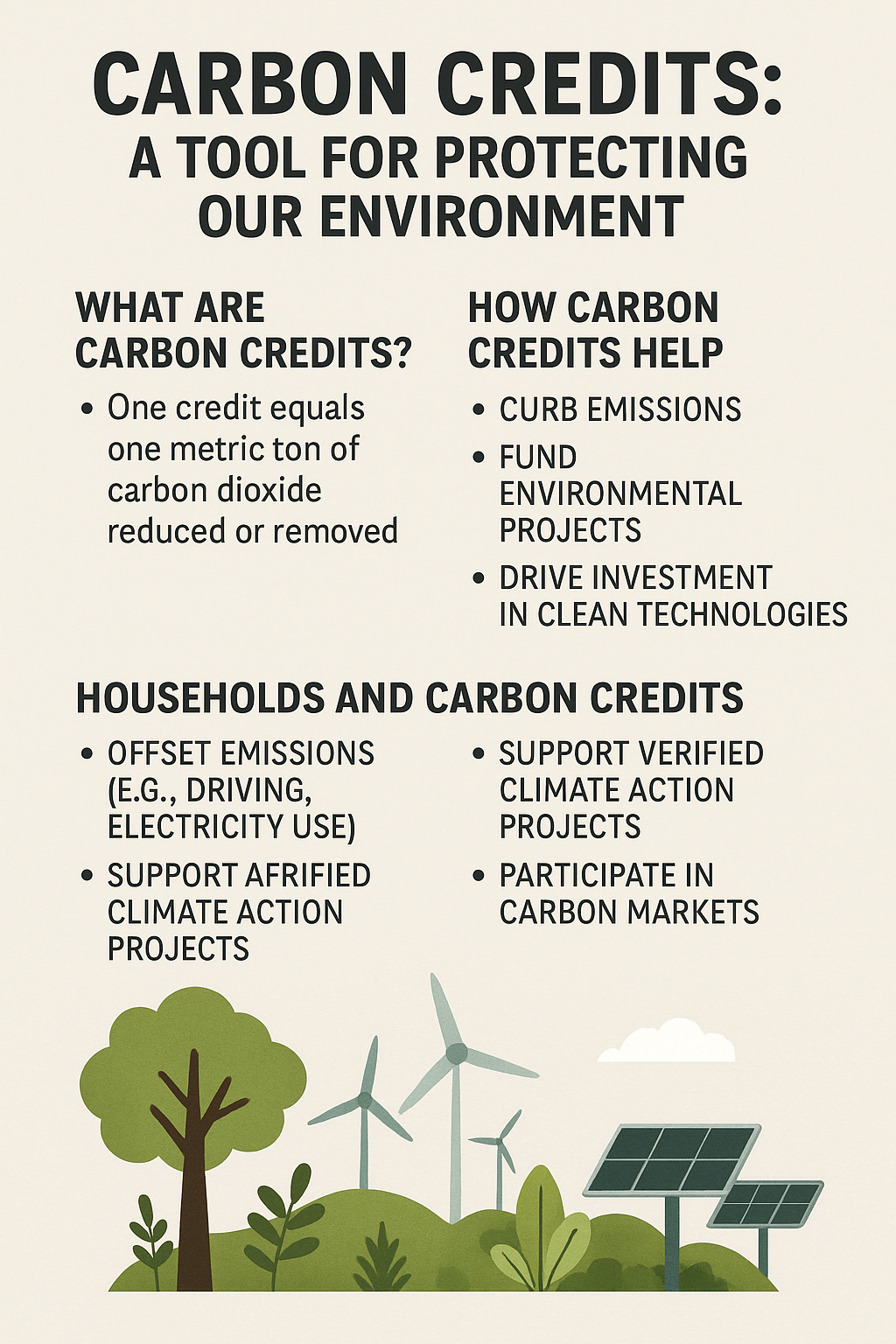
A carbon credit represents one metric ton of carbon dioxide (CO₂) — or an equivalent amount of another greenhouse gas — that has been prevented from entering the atmosphere or removed from it. Entities that reduce emissions beyond their set targets can earn these credits. Others, especially companies that cannot immediately cut emissions, can purchase these credits to offset their carbon footprint.
This market-based mechanism incentivizes emission reductions, funds environmental projects (like reforestation, renewable energy, and soil carbon capture), and drives investment into low-carbon technologies.
How Carbon Credits Help Industries — and Why That Matters
Industries across the globe, particularly those with high emissions (like energy, manufacturing, and aviation), are increasingly participating in carbon markets to meet their environmental obligations. By buying carbon credits, these companies support projects that capture or avoid emissions elsewhere, thus balancing out their impact.
This system has catalyzed massive investments into clean energy, conservation efforts, and climate innovation. It is not just a compliance tool — it is a bridge toward a greener economy.
Households and Carbon Credits: A New Frontier
While industries are leading adopters today, the real transformation lies ahead — when households and individuals begin participating in carbon markets.
Imagine if every family could:
a) Offset emissions from car usage, electricity consumption, or air travel by purchasing affordable carbon credits.
b) Support local and global projects such as tree-planting drives, renewable microgrids, or community composting centers.
c) Be part of verified climate action movements simply by making informed choices.
Today, several platforms allow individuals to calculate their carbon footprint and voluntarily purchase certified carbon credits to neutralize their emissions. Projects range from restoring forests in India to installing solar power systems in rural villages.
The impact could be revolutionary: If millions of households start offsetting even a fraction of their emissions, the collective effect would mirror that of major policy changes — driven not by governments alone, but by everyday people.
Why It Matters Now
a) Climate deadlines are looming: Scientists agree that we must halve global emissions by 2030 to avoid the worst impacts of climate change.
b) Behavioral change matters: Small shifts in individual behavior, combined with systemic tools like carbon credits, can accelerate global progress.
c) New markets are opening up: Emerging platforms are making it easier, cheaper, and more transparent for households to participate.
d) Community empowerment: Localized offset programs can directly benefit communities by funding sustainable agriculture, water conservation, and clean energy.
Carbon credits are not just financial instruments — they are a symbol of accountability and hope. By embracing carbon markets not only at the industry level but also at the household level, we can democratize climate action.
Governments, NGOs, and tech companies should work together to make carbon credits accessible, affordable, and trustworthy for individuals. Educational campaigns, household-level calculators, and easy-to-use platforms are needed to bridge the gap.
As citizens of this planet, our choices matter. Whether it’s buying eco-certified products, supporting clean energy, or offsetting our unavoidable emissions, we have the tools at hand.
The future of climate action is not only corporate — it is personal.